How often should you pump your septic tank?
The answer depends on your household, your tank, and what you put down the drain. Here is how to figure out the right schedule.
August 20, 2026 · 3 min read
The short answer: every 3 to 5 years
Most residential septic tanks need pumping every 3 to 5 years. That is the range the EPA and most state health departments recommend, and it holds true for a typical household of 2 to 4 people on a 1,000 to 1,500 gallon tank. But the range is wide because usage varies, and usage is what actually drives the schedule.
What changes the interval
The two biggest factors are household size and tank capacity. More people means more water and more solids entering the tank every day. A family of five on a 1,000 gallon tank may need pumping every 2 to 3 years, while a couple on a 1,500 gallon tank might go 5 years between pump-outs.
Garbage disposals shorten the interval. Ground food waste adds solids that would otherwise go in the trash, and those solids take up space in the tank. Households with a garbage disposal typically need pumping about a year sooner than those without one.
Laundry habits matter too. Spreading loads throughout the week gives the tank time to settle between surges. Running five loads on Saturday pushes a large volume of water through the tank at once, which can flush solids into the drain field before they have time to settle.
Warning signs that a pump-out is overdue
- Slow drains in more than one fixture. A single slow drain is usually a local clog, but when the kitchen sink, the shower, and the toilet all drain slowly, the tank may be full.
- Sewage odors near the tank or in the yard above the drain field. Gases from a full tank escape through any opening they can find.
- Standing water or unusually green grass over the tank or drain field. Effluent reaching the surface means the system cannot absorb any more.
- Sewage backing up into the lowest drain in the house, typically a basement floor drain or a ground-level bathtub.
What happens during a pump-out
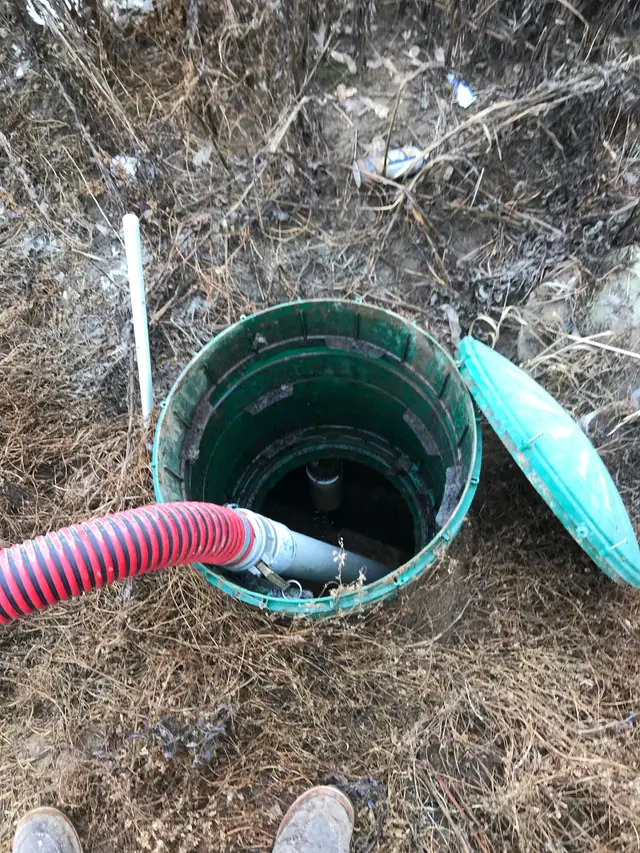
The vacuum truck parks near the tank and a hose is run from the truck to the tank opening. The pump draws out both the liquid and the settled solids. On a standard residential tank, the job takes about 30 to 45 minutes once the lid is open. If the access lid is buried, digging it out adds time. A riser can be installed to bring the lid to grade level so future pump-outs are faster.
While the tank is open, the technician checks the inlet and outlet baffles. These are the internal walls that direct flow through the tank and keep solids from leaving. Damaged baffles are a common cause of premature drain field failure, and they are only visible when the tank is empty.
Keeping the tank healthy between pump-outs
- Do not pour cooking grease down the drain. It solidifies in the tank and builds up the scum layer faster than normal use.
- Avoid flushing anything other than toilet paper. Wipes, feminine products, and paper towels do not break down in a septic tank.
- Fix running toilets and leaking faucets. Excess water entering the tank dilutes the bacterial action that breaks down solids.
- Do not use septic tank additives unless specifically recommended by a professional. Most are unnecessary, and some can actually harm the bacterial balance in the tank.
Schedule a pump-out with Reynolds Pumping
Reynolds Pumping and Septic Services handles residential and commercial septic pump-outs across Mississippi and Louisiana. Chase Reynolds picks up the phone 24 hours a day, 7 days a week, at (601) 551-0837. He can check your tank, tell you where it stands, and recommend when the next pump-out should be.
Reynolds Pumping and Septic Services, (601) 551-0837
Call (601) 551-0837More articles
5 signs your septic system needs repair
A septic system does not fail all at once. These are the early signs that something needs attention.
What to expect when you rent a portable toilet
Whether it is a construction site or a weekend event, here is how the process works from delivery to pickup.